Vital Wrestler 💨
Don’t Smoke. It’s Bad for You.
Many of my friends were heavy smokers. I had been trying for a while to help them quit by explaining how badly smoking affects physical performance. They did not seem to take my advice seriously, so I decided to make a device that would help them feel the effects for themselves.
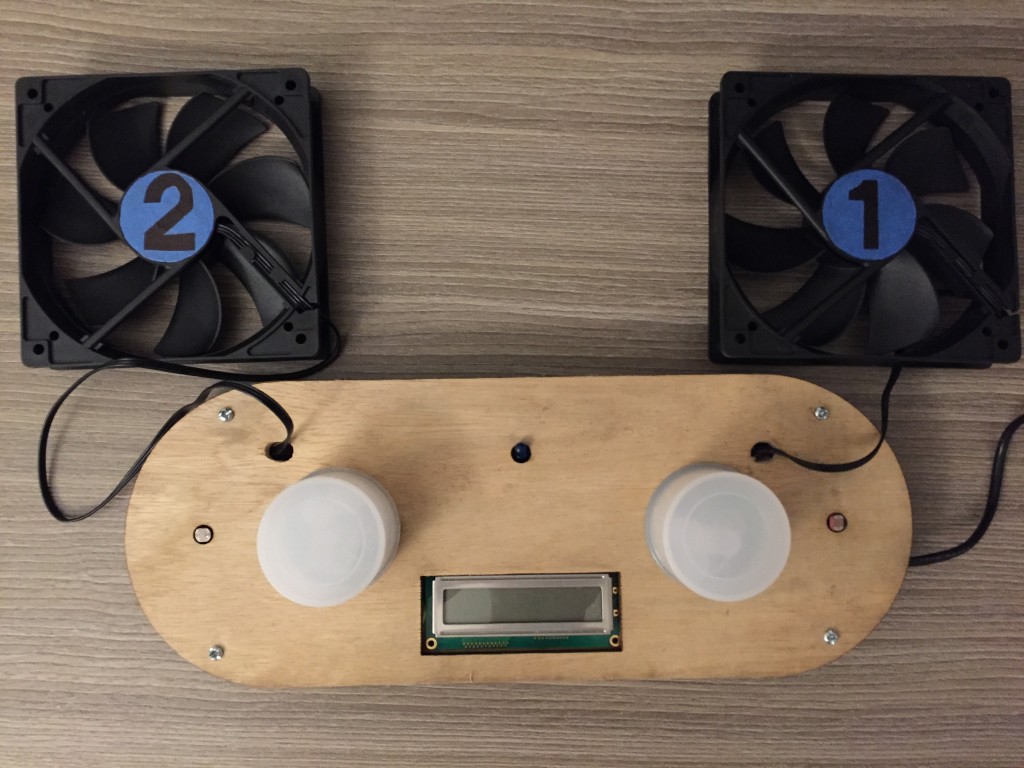
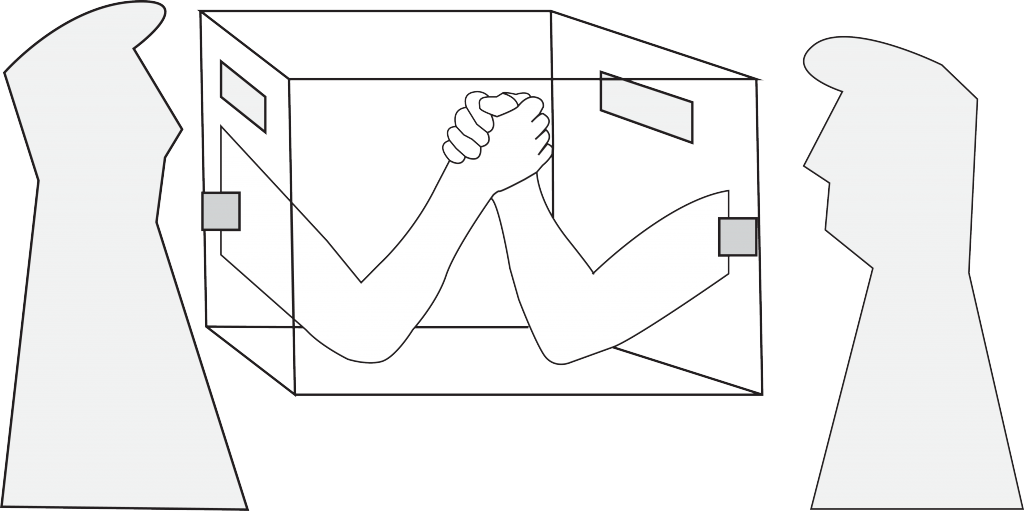
When I ran cross-country in high school, our coach brought us balloons for a monthly competition. Whoever popped a balloon first, or had the largest balloon when time ran out, earned the day off. We called it “vital wrestling.” I used that idea for my midterm and built an interactive wrestling machine in which two players compete by blowing into fans. Whoever pushes the other player’s hand down wins.
Schematic Diagram
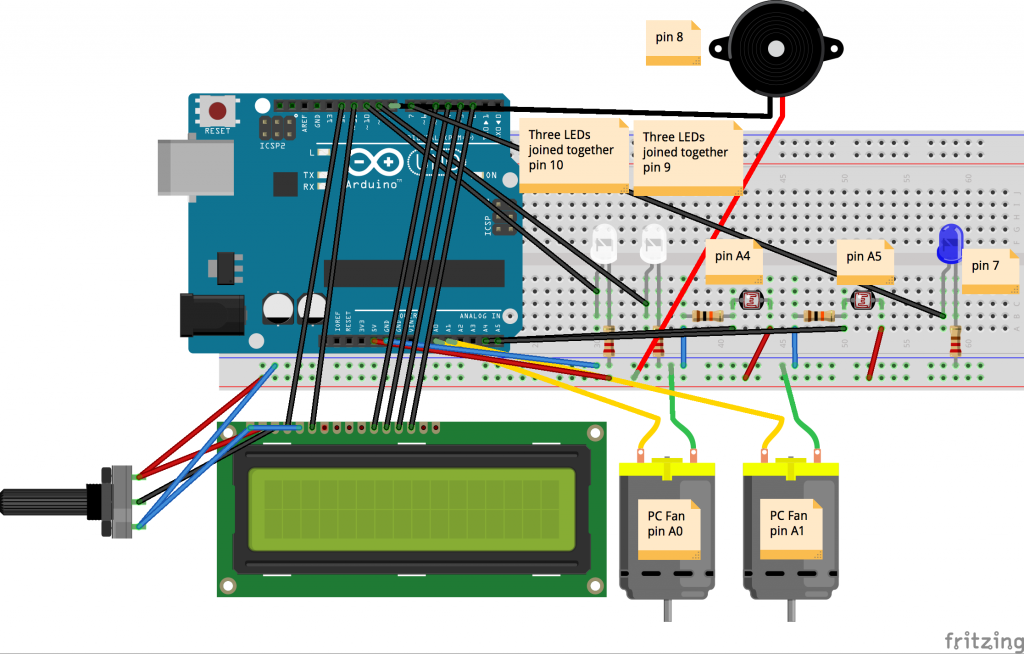
Code
vital_wrestling.ino
#include <LiquidCrystal.h>

LiquidCrystal lcd(12, 11, 5, 4, 3, 2);

#define LED1 10
#define LED2 6
#define Blue 13
#define FAN1 A0
#define FAN2 A1
#define Button 2


int caseState, val1, val2, buttonVal, photoVal1, photoVal2, fadeLevel1, fadeLevel2, interval, winner, pos, limit, diff1, diff2;

unsigned long timer1, timer2;

void setup() {
  pinMode(LED1, OUTPUT);
  pinMode(LED2, OUTPUT);
  pinMode(Blue, OUTPUT);
  pinMode(Button, INPUT);
  //servo.attach(5);
  analogWrite(FAN1, 0);
  analogWrite(FAN2, 0);
  lcd.begin(16,2);
  Serial.begin(9600);

}

void loop() {

  val1 = analogRead(FAN1); //analog read fan1
  val2 = analogRead(FAN2); //analog read fan2
  logic();
  debug();

}
tone_and_display.ino
//custom set tone code for my laziness
void setTone(int x) {
  return (tone(8, x, 10));
}


//isolate "begin serial print" for easy edit
void beginDis() {
  Serial.println("Ready!");
  lcd.clear();
  lcd.setCursor(5, 0);
  lcd.print("Ready!");
  setTone(3000);
  delay(1500);
  Serial.println(3);
  lcd.clear();
  lcd.setCursor(7, 0);
  lcd.print(3);
  setTone(4000);
  delay(1000);
  Serial.println(2);
  lcd.clear();
  lcd.setCursor(7, 0);
  lcd.print(2);
  setTone(4000);
  delay(1000);
  Serial.println(1);
  lcd.clear();
  lcd.setCursor(7, 0);
  lcd.print(1);
  setTone(4000);
  delay(1000);
  setTone(2000);
  lcd.clear();
  lcd.setCursor(6, 0);
  lcd.print("GO!");
  Serial.println("GO!");
}


//isolate win tone for easy edit
void winTone() {
  tone(8, 1000, 800);
  delay(100);
  tone(8, 3500, 1000);
}
timerCal.ino
//transfer fan analog read data into LED fade level
void timerCal() {
  long cTime = millis();

  if (cTime - timer1 >= interval) { //debouncing
    if (val1 != 0) {
      diff1 = (int)(val1 / 10); //measure how hard player one blows
      fadeLevel1 += diff1; //apply addition
    }

    timer1 = cTime; //resetting timer1
  }

  if (cTime - timer2 >= interval) { //debouncing
    if (val2 != 0) {
      diff2 = (int)(val2 / 10); //measure how hard player two blows
      fadeLevel2 += diff2; //apply addition
    }

    timer2 = cTime; //resetting timer2
  }
}
reset.ino
//reset the game
void reset() {
  fadeLevel1 = 0;
  fadeLevel2 = 0;
  limit = 0;
  //servo.write(90);
  analogWrite(LED1, fadeLevel1);
  analogWrite(LED2, fadeLevel2);
  caseState = 0;
}
logic.ino
void logic() {
  photoVal1 = analogRead(A4);
  photoVal2 = analogRead(A5);
  switch (caseState) {
    case 0:
      //      buttonVal = 0;
      //      buttonVal = digitalRead(Button);
      //      if (val1 < 80 && val2 < 80 && abs(val1 - val2) <= 2) {
      //        if (limit < 1) { //limit the serial print to print one
      //          Serial.println("Press the button to start!");
      //        }
      //

      digitalWrite(Blue, HIGH);
      if (limit < 1) { //limit the serial print to print one
        Serial.println("Press the sensors to start!");
        lcd.clear();
        lcd.print("Press the sensor");
        lcd.setCursor(0, 1);
        lcd.print("to start!");
      }

      limit = 1; //stop the if statement above

      if (photoVal1 <= 100 && photoVal2 <= 100) caseState++; //move to next case

      break;

    case 1:
      beginDis();
      caseState++;
      break;

    case 2:
      //buttonVal = 0;
      limit = 0;
      interval = 100;

      //measureWin(fadeLevel1, fadeLevel2);

      timerCal();

      analogWrite(LED1, fadeLevel1);
      analogWrite(LED2, fadeLevel2);


      if (fadeLevel1 >= 255) {
        fadeLevel1 = 255;
        winner = 1;
        caseState++;
      }

      if (fadeLevel2 >= 255) {
        fadeLevel1 = 255;
        winner = 2;
        caseState++;
      }

      Serial.print("Fan 1 =  ");
      Serial.print(val1);
      Serial.print("\t");
      Serial.print("Fan 2 =  ");
      Serial.print(val2);
      Serial.print("\t");
      Serial.print("1 =  ");
      Serial.print(fadeLevel1);
      Serial.print("\t");
      Serial.print("2 =  ");
      Serial.print(fadeLevel2);
      Serial.println();
      lcd.clear();
      lcd.setCursor(2, 0);
      lcd.print("P2");
      lcd.setCursor(12, 0);
      lcd.print("P1");
      lcd.setCursor(2, 1);
      lcd.print(fadeLevel2);
      lcd.setCursor(12, 1);
      lcd.print(fadeLevel1);

      break;

    case 3:
      if (winner == 1) {

        analogWrite(LED1, 255);
        Serial.println("Player one wins!");
        lcd.clear();
        lcd.print("Player one");
        lcd.setCursor(0, 1);
        lcd.print("wins!");
        winTone();

      } else {

        analogWrite(LED2, 255);

        Serial.println("Player two wins");
        lcd.clear();
        lcd.print("Player two");
        lcd.setCursor(0, 1);
        lcd.print("wins!");
        winTone();

      }

      delay(8000);
      setTone(2000);
      caseState++;
      break;

    case 4:
      if (limit < 1) {
        Serial.println("Press the sensors to restart");
        lcd.clear();
        lcd.print("Press the sensor");
        lcd.setCursor(0, 1);
        lcd.print("to restart!");
      }
      limit = 1;

      if (photoVal1 <= 100 && photoVal2 <= 100) reset();
      break;
  }

}
debug.ino
void debug(){
  Serial.print("Fan 1 =  ");
  Serial.print(val1);
  Serial.print("\t");
  Serial.print("Fan 2 =  ");
  Serial.print(val2);
  Serial.print("\t");
  Serial.print("Case State =  ");
  Serial.print(caseState);
  Serial.print("\t");
  Serial.print("Button =  ");
  Serial.print(buttonVal);
  Serial.print("\t");
  Serial.print("Photocell 1 =  ");
  Serial.print(photoVal1);
  Serial.print("\t");
  Serial.print("Photocell 2 =  ");
  Serial.print(photoVal2);
  Serial.println();
}
Build Process
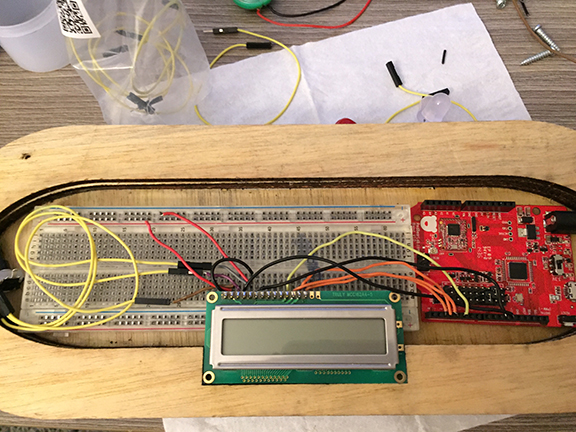
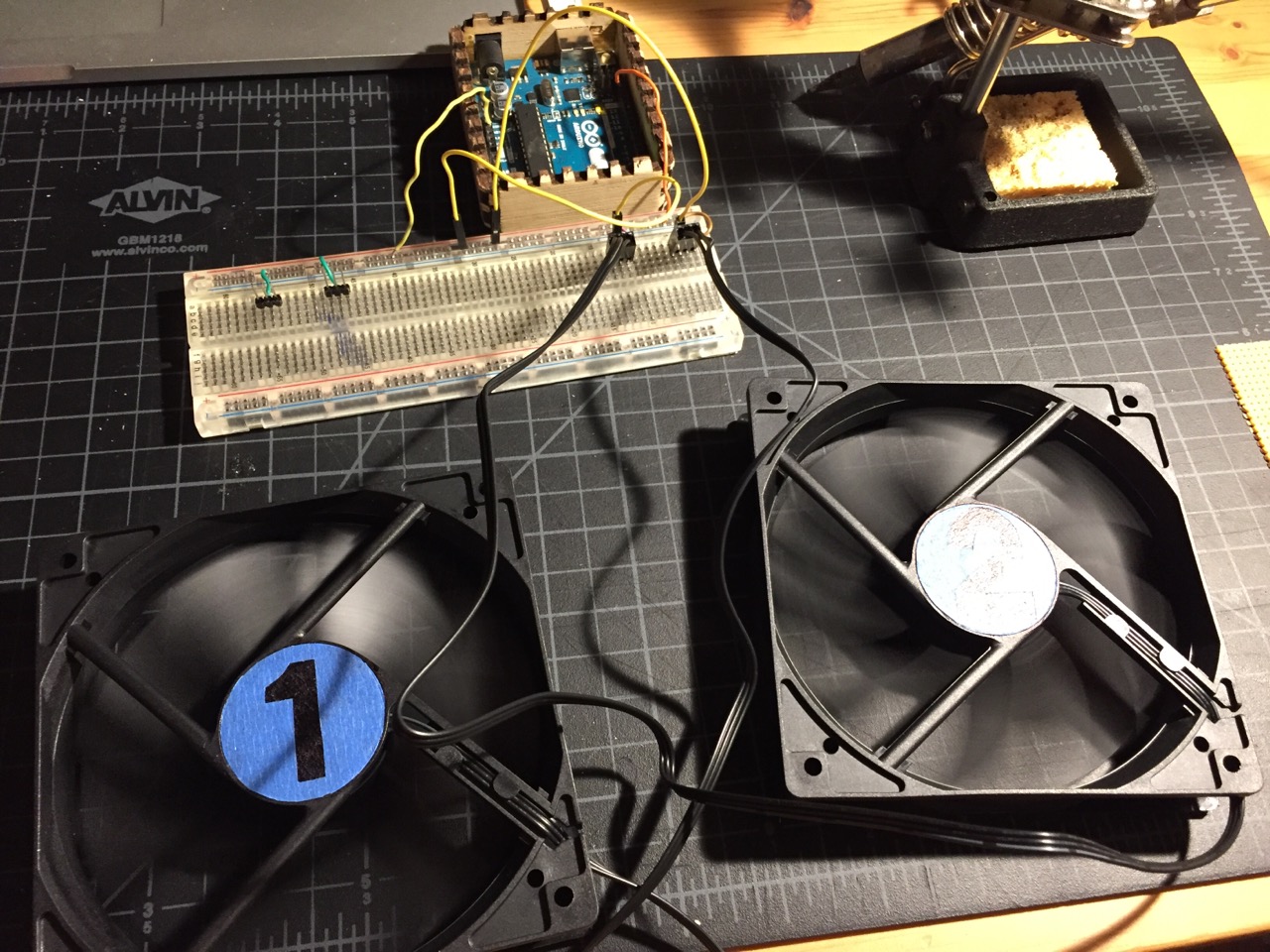
When I got the PC fans, I spent a long time searching for a guide to using them as analog input devices for an Arduino. I could not find one, so I connected their power lines to A10 and A1 and connected ground to ground. They worked like regular analog devices, producing larger values as I blew harder.
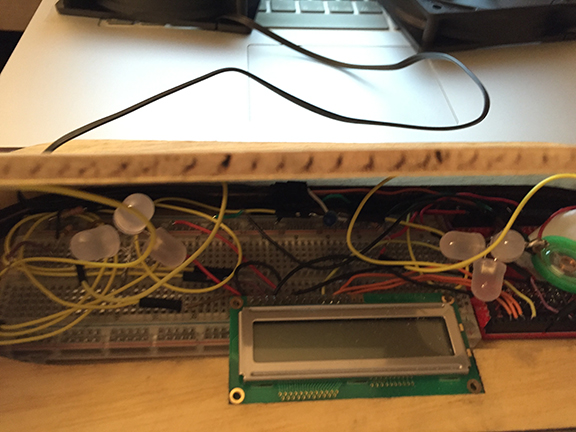
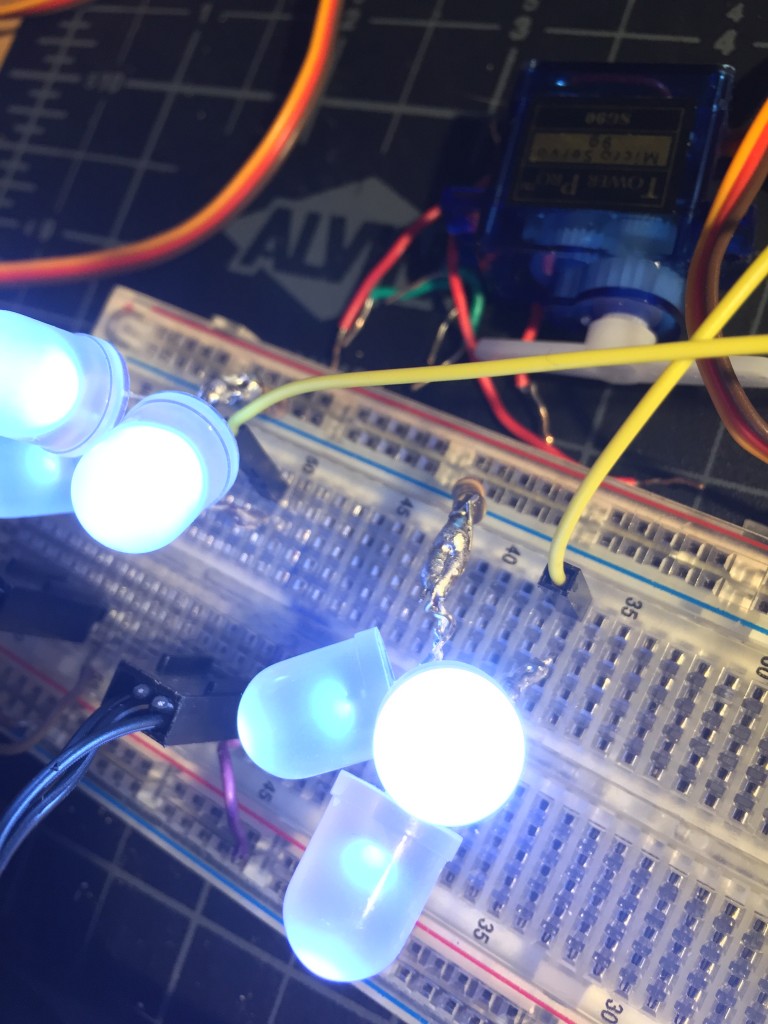
I figured one LED per player would not be bright enough for the gameplay, so I soldered three LEDs together to make a brighter indicator.
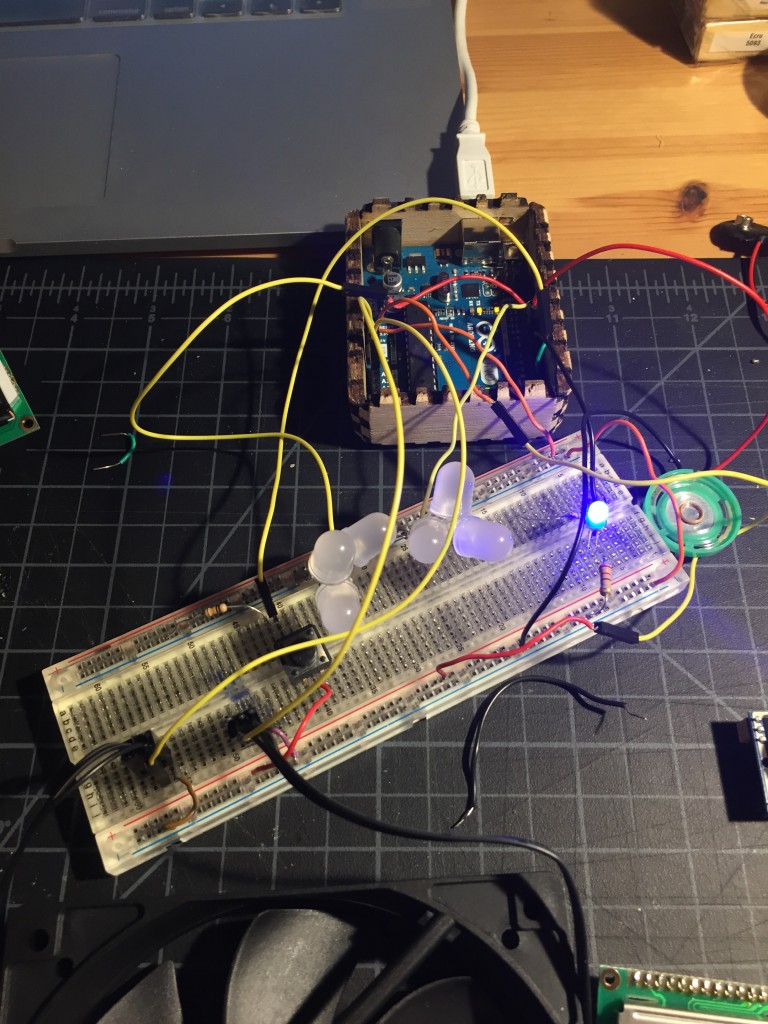
I added a buzzer for the start, victory, and restart sounds.
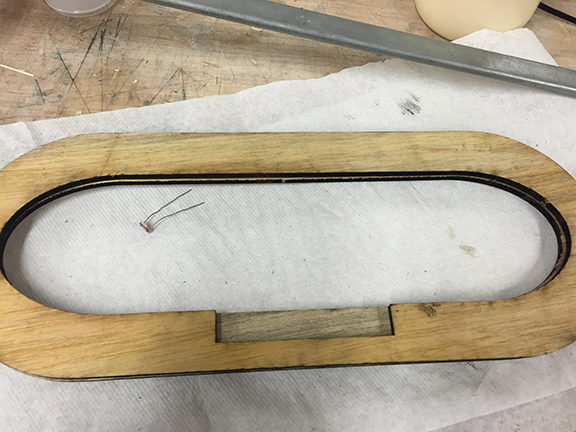
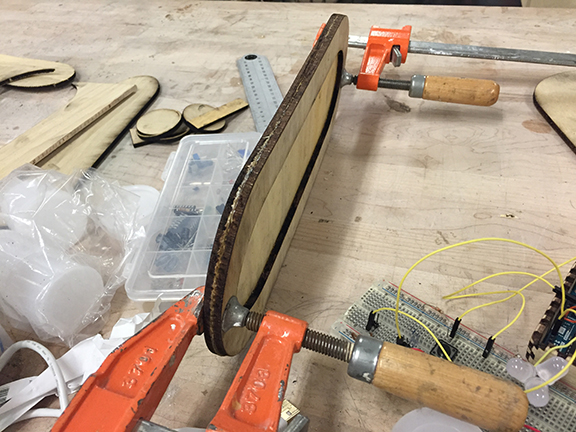
Laser-Cutting the Case
Putting Everything Together